> For the complete documentation index, see [llms.txt](https://documentation.opencrvs.org/llms.txt). Markdown versions of documentation pages are available by appending `.md` to page URLs; this page is available as [Markdown](https://documentation.opencrvs.org/technical/guides/configuration/integrations/create-a-client.md).
# Create a client
#### Introduction
In order to interoperate with OpenCRVS' via APIs, you must create a system client.
You can create a system client to perform record search & event notifications from a health system via the National System Administrator UI.
From 2.0.1 you can also create clients with whatever scopes you wish from your country configuration, without going through the UI. See [Process of creation via the country configuration](#process-of-creation-via-the-country-configuration) below.
The option to create clients for managing Locations, Importing Legacy Records or integrating with Citizen Portals via the UI has been deprecated for security reasons in 2.0, as these clients are extremely powerful.
Docs will be updated in this section by Aug 2026 to include information on the creation of those types of client.
***
#### Process of creation via the UI
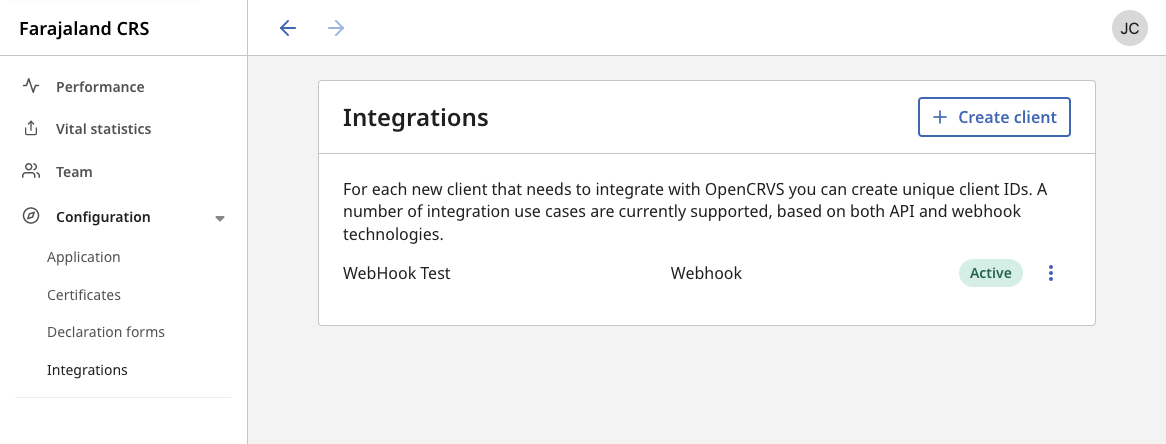
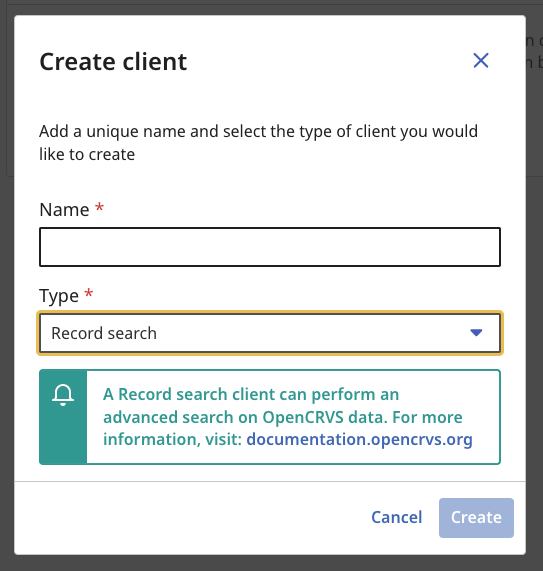
Click **+ Create client**
You will see a modal overlay where you can select the type of client you wish to create. The business functionality available for each client is explained in subsequent pages in this section of our documentation.
**The type of client you create is important and can only perform API requests associated with the business functionality relevant to that type.** A Record Search client is not authorized to perform an Event Notification for example.
You must give each client a unique name.
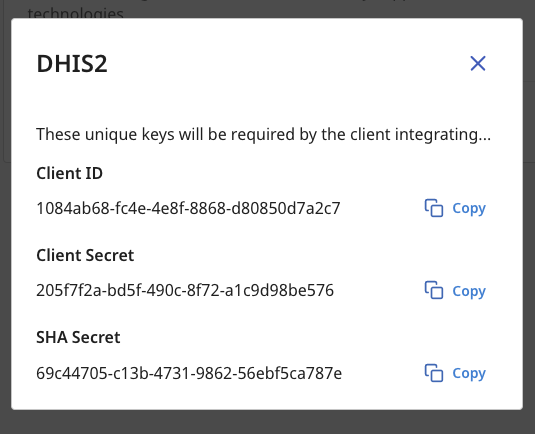
When you click "Create", you will be shown the authentication details for the client along with a SHA Secret used to sign, encrypt, decrypt and verify the authenticity of payloads.
{% hint style="warning" %}
**You must copy these keys now! The Client Secret will never be displayed to you again and it cannot be retrieved from our database as it is encrypted. It can only be refreshed in the UI.**
{% endhint %}
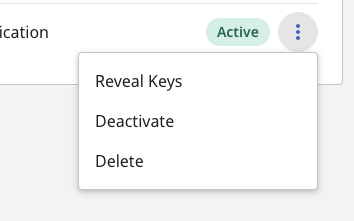
6\. You can manage existing clients by using the **3 dots** menu after the client has been created. You can **reveal the Client ID and SHA Secret keys** at any time and **refresh the Client Secret** to create a new one by selecting "**Reveal Keys**".
{% hint style="warning" %}
When you refresh a Client Secret, the old secret will no longer work for authentication.
{% endhint %}
You can also temporarily "**Deactivate**" and "**Enable**" a client or alternatively "**Delete**" it.
{% hint style="danger" %}
All client behaviour is audited and is ultimately the personal responsibility of the National System Administrator of OpenCRVS that created the client. Protect citizen data and do not expose access unnecessarily, as you may be in breach of local privacy laws.
{% endhint %}
***
#### Process of creation via the country configuration
{% hint style="info" %}
Available from OpenCRVS **2.0.1**. The same capability exists in the 1.9 line from **1.9.16**, where the country configuration registers integrations through the user management service instead of the events service. See the v1.9 documentation for that version.
{% endhint %}
A client created in the UI is limited to the permissions that come with its type. When an integration needs a different set — a national ID system that registers birth and death records on its own authority, for example — declare it in your country configuration instead.
The reason to give an integration its own client, rather than letting it reuse the access token of whichever user triggered the call, is the audit trail. A client that authenticates as itself is recorded as itself in a record's history. One that borrows a registrar's token is indistinguishable from that registrar afterwards.
Clients registered this way appear in the Integrations list alongside the ones created in the UI, where a National System Administrator can reveal their keys, deactivate them or delete them.
**1. Implement the system ready trigger**
Your country configuration exposes a `GET /trigger/system/ready` endpoint. The reference country configuration routes it to `systemReadyHandler` in `src/api/integration/handler.ts`, which registers every integration listed in its `INTEGRATIONS` array. The list ships empty, so an unmodified country configuration registers nothing and answers `200`. If your country configuration answers `404` or `501`, OpenCRVS reads it as "this country has no integrations to register":
```typescript
// src/index.ts
server.route({
method: 'GET',
path: '/trigger/system/ready',
handler: systemReadyHandler,
options: {
tags: ['api', 'integration'],
description:
'Called by events on startup. Registers integrations in the events service using the provided bootstrap token.'
}
})
```
{% hint style="info" %}
Before OpenCRVS 2.1 this route was `/triggers/system/ready`. `npx @opencrvs/toolkit upgrade` renames it for you.
{% endhint %}
OpenCRVS calls this endpoint during provisioning and passes a bearer token that already carries the `integration.create` scope. Your handler should forward that token rather than authenticating again.
**2. Register each integration**
Add each integration to `INTEGRATIONS`. The handler posts each one to `POST /integrations` on the events service, and skips any name that is already registered, so restarts never overwrite a secret a National System Administrator has rotated. Unless you pre-share credentials (see below), nothing needs to be stored in your country configuration — the credentials are generated by OpenCRVS and returned in the response. A simplified version of the handler:
```typescript
// src/api/integration/handler.ts
import * as Hapi from '@hapi/hapi'
import fetch from 'node-fetch'
import { logger } from '@countryconfig/logger'
import { EVENTS_URL } from '@countryconfig/constants'
import { encodeScope, Scope } from '@opencrvs/toolkit/scopes'
const INTEGRATIONS: { name: string; scopes: Scope[] }[] = [
{
name: 'MOSIP',
scopes: [
{ type: 'record.action.accept', options: { event: ['birth', 'death'] } },
{ type: 'record.action.reject', options: { event: ['birth', 'death'] } },
{ type: 'record.read', options: { event: ['birth', 'death'] } }
]
}
]
export async function systemReadyHandler(
request: Hapi.Request,
h: Hapi.ResponseToolkit
) {
for (const integration of INTEGRATIONS) {
const res = await fetch(new URL('/integrations', EVENTS_URL).toString(), {
method: 'POST',
headers: {
'Content-Type': 'application/json',
Authorization: request.headers.authorization
},
body: JSON.stringify({
name: integration.name,
scopes: integration.scopes.map(encodeScope)
})
})
if (!res.ok) {
logger.warn(
`Registering "${integration.name}" failed: ${res.status} ${await res.text()}`
)
}
}
return h.response().code(200)
}
```
`EVENTS_URL` must point at the events service on the internal network (`http://events:5555/` in the default deployment). From OpenCRVS 2.1 it is required: it has no production default, so the country configuration service does not start without it, whether or not any integrations are configured.
**Request payload**
| Parameter | Type | Description |
| ------------- | ------------------------------------------ | --------------------------------------------------------------------------------------------------------------------------------------------------------------------------------------------------------------- |
| `name` | string | A unique name for the client, shown in the Integrations list |
| `scopes` | string\[] | At least one encoded scope string (see below) |
| `credentials` | `{ clientId: UUID, clientSecret: string }` | Optional. Pre-shared credentials the integrating system already holds, so it can authenticate immediately without a **Reveal keys** step. Both must be given. Returns `409 CONFLICT` if the client id is taken. |
**Response**
```json
{
"clientId": "2fd153ab-86c8-45fb-990d-721140e46061",
"clientSecret": "8636abe2-affb-4238-8bff-200ed3652d1e",
"shaSecret": "b0d5e0a1-1f57-4f2e-9c9e-0c7d1a3f2b44"
}
```
The `clientSecret` is returned only in this response and is not retrievable afterwards. Either hand it to the integrating system from your handler, or discard it and have a National System Administrator use **Reveal keys** → **Refresh secret** on the Integrations page to issue a new one.
**Scopes**
Scopes are passed as encoded strings in query-string format: `type=&