> For the complete documentation index, see [llms.txt](https://documentation.opencrvs.org/llms.txt). Markdown versions of documentation pages are available by appending `.md` to page URLs; this page is available as [Markdown](https://documentation.opencrvs.org/technical/guides/configuration/administrative-hierarchy/how-to-configure-place-of-event.md).
# How to configure place of event
## Where do events take place?
Each event has a `placeOfEvent` property in its indexed format (`EventIndex`). All jurisdiction questions are resolved against this property. `placeOfEvent` is a metadata field that defaults to the user's location.
For some events, it may be more appropriate to specify a different field to determine where the event took place. This [field is defined at the root of the event configuration.](https://github.com/opencrvs/opencrvs-core/blob/v2.1.0/packages/countryconfig-template/src/events/birth/index.ts)
### Field types for `placeOfEvent`
`placeOfEvent` accepts both administrative area and location field types as reference values.
**Example: Birth event**
Relying on the default behaviour — using the user's location as the `placeOfEvent` value — works in some cases:
* A hospital clerk assigned to the hospital where the birth took place. :white\_check\_mark:
* An office worker declaring the birth with the informant at the office. :x:
Since a birth can happen anywhere, relying solely on locations available in the system may be insufficient. An alternative is to use the `Address` field type, which allows dynamic configuration of an exact address. In this case, `placeOfEvent` takes the most precise administrative area as its value, allowing the system to still use `placeOfEvent` to determine user jurisdiction.\
\
**Fallback behaviour**
| Scenario | `placeOfEvent` value |
| ---------------------------------------------------------------- | -------------------- |
| No explicit `placeOfEvent` defined in config | User's location |
| Explicit `placeOfEvent` defined, but empty in the declaration | User's location |
| Explicit `placeOfEvent` defined and submitted in the declaration | Value from the field |
#### Using multiple fields for `placeOfEvent`
As of OpenCRVS v2.0, `placeOfEvent` does not directly support arrays.
In the [example birth event](https://github.com/opencrvs/opencrvs-core/blob/v2.1.0/packages/countryconfig-template/src/events/birth/forms/pages/child.ts), the form renders different fields based on the `SELECT` field `child.placeOfBirth`.
The following shows the available options for birth location and how `placeOfEvent` is configured to reference a single field:
```
{
placeOfEvent: field('child.birthLocationId')
}
```
\
The `birthLocationId` field, of type `ALPHA_HIDDEN`, is an invisible field that can take an array of field references as its value:
{% hint style="info" %}
Note: `ALPHA_HIDDEN` is alpha version. This means we might not support it in the future, or we may introduce breaking changes in the future.
{% endhint %}
```typescript
{
id: 'child.birthLocationId',
type: FieldType.ALPHA_HIDDEN,
required: false,
label: {
defaultMessage: 'Health Institution',
description: 'This is the label for the field',
id: 'event.birth.action.declare.form.section.child.field.birthLocation.label'
},
parent: [
field('child.placeOfBirth'),
field('child.birthLocation'),
field('child.birthLocation.privateHome'),
field('child.birthLocation.other')
],
value: [
field('child.birthLocation'),
field('child.birthLocation.privateHome').get('administrativeArea'),
field('child.birthLocation.other').get('administrativeArea')
]
},
```
`placeOfEvent` receives the first visible value, so it is important to configure the declaration form so that only one field option is rendered at a time.
\ 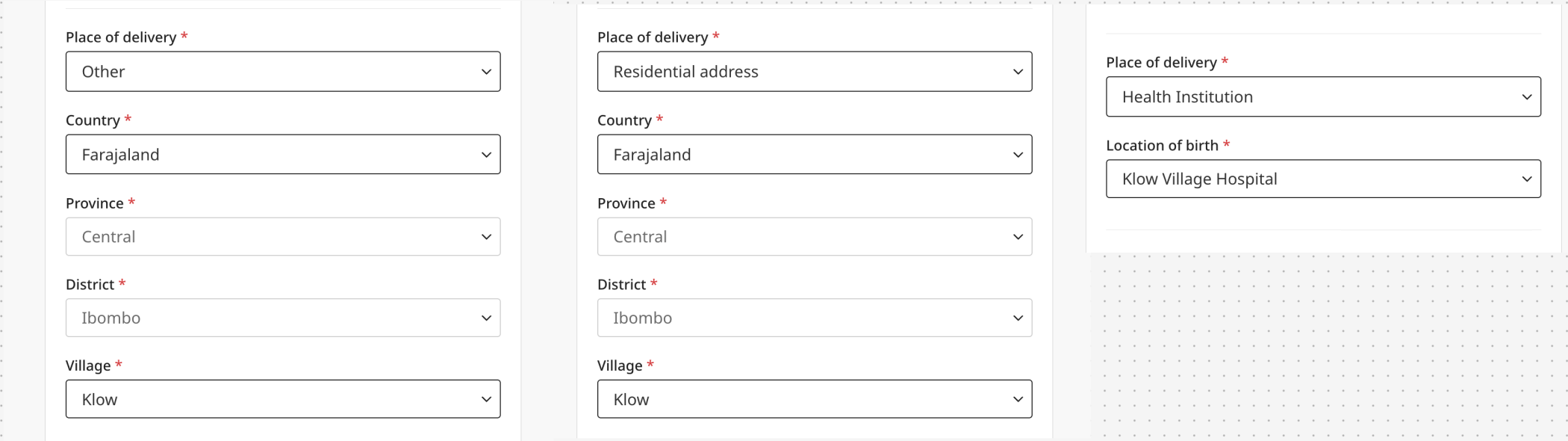 \ Rendered options for birth location
---
# Agent Instructions
This documentation is published with GitBook. GitBook is the documentation platform designed so that both humans and AI agents can read, navigate, and reason over technical content effectively. Learn more at gitbook.com.
## Querying This Documentation
If you need additional information that is not directly available in this page, you can query the documentation by asking a question.
Perform an HTTP GET request on the following URL with the `ask` and `goal` query parameters:
```
GET https://documentation.opencrvs.org/technical/guides/configuration/administrative-hierarchy/how-to-configure-place-of-event.md?ask=&goal=
```
`ask` is the immediate question: it should be specific, self-contained, and written in natural language.
`goal` is what the user is ultimately trying to achieve, the reason they need the answer. Sharing it helps GitBook give you a better, more relevant answer. A goal is most helpful when it describes the outcome the user wants rather than restating the question. For example, with `ask=how do I create an API token`, a goal like `automate deployments from our CI pipeline` lets GitBook tailor the answer to that use case.
The response will contain a direct answer to the question and relevant excerpts and sources from the documentation.
Use this mechanism when the answer is not explicitly present in the current page, you need clarification or additional context, or you want to retrieve related documentation sections.
\ Rendered options for birth location
---
# Agent Instructions
This documentation is published with GitBook. GitBook is the documentation platform designed so that both humans and AI agents can read, navigate, and reason over technical content effectively. Learn more at gitbook.com.
## Querying This Documentation
If you need additional information that is not directly available in this page, you can query the documentation by asking a question.
Perform an HTTP GET request on the following URL with the `ask` and `goal` query parameters:
```
GET https://documentation.opencrvs.org/technical/guides/configuration/administrative-hierarchy/how-to-configure-place-of-event.md?ask=&goal=
```
`ask` is the immediate question: it should be specific, self-contained, and written in natural language.
`goal` is what the user is ultimately trying to achieve, the reason they need the answer. Sharing it helps GitBook give you a better, more relevant answer. A goal is most helpful when it describes the outcome the user wants rather than restating the question. For example, with `ask=how do I create an API token`, a goal like `automate deployments from our CI pipeline` lets GitBook tailor the answer to that use case.
The response will contain a direct answer to the question and relevant excerpts and sources from the documentation.
Use this mechanism when the answer is not explicitly present in the current page, you need clarification or additional context, or you want to retrieve related documentation sections.