> For the complete documentation index, see [llms.txt](https://documentation.opencrvs.org/llms.txt). Markdown versions of documentation pages are available by appending `.md` to page URLs; this page is available as [Markdown](https://documentation.opencrvs.org/implementation/your-opencrvs-project/solution-architecture.md).
# Solution architecture
### 1. Introduction
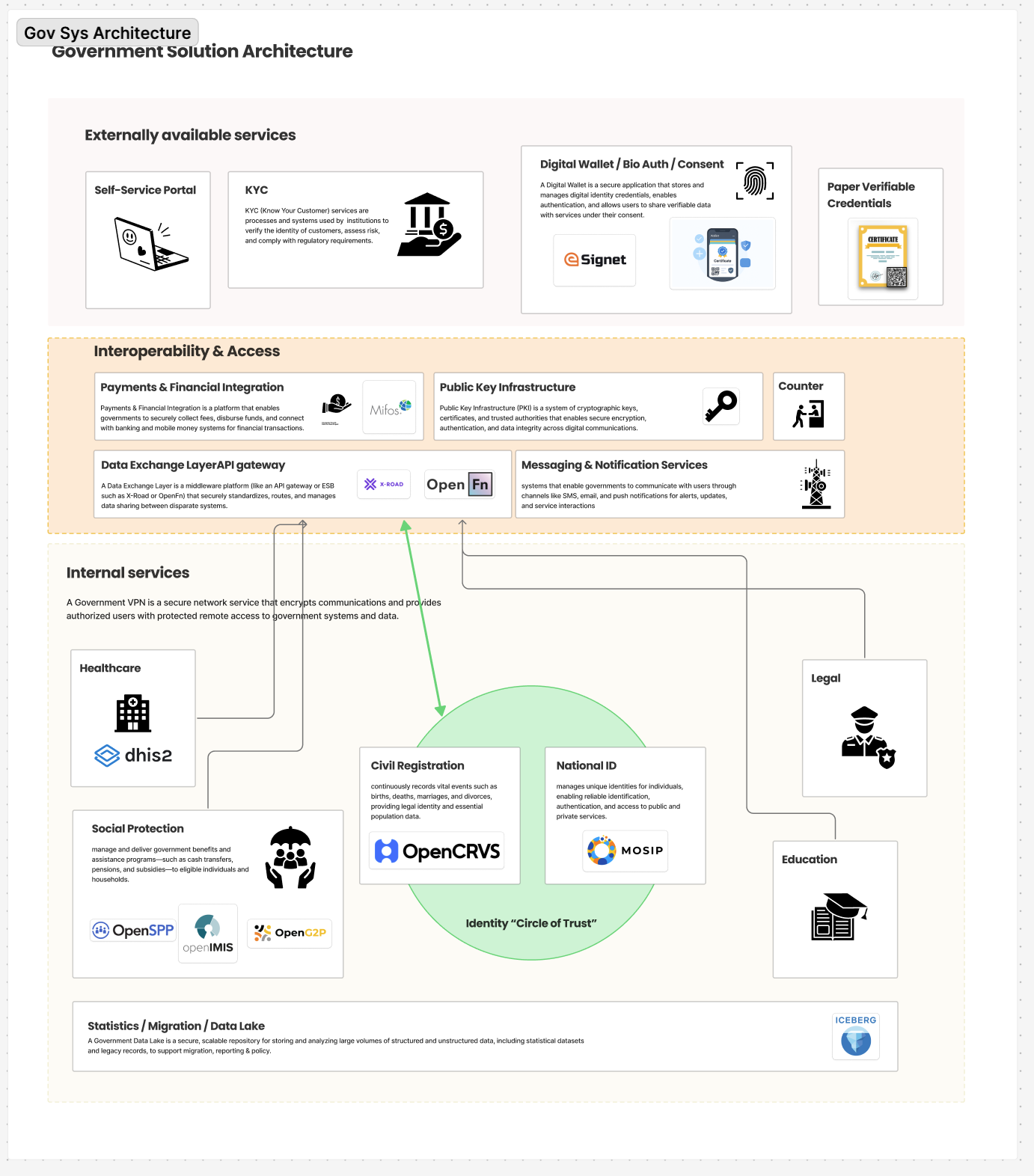
OpenCRVS is a core component of a country's Digital Public Infrastructure (DPI), designed as an internal, staff-facing civil registration system used by registrars and government officials to record vital events such as births and deaths.
Civil registration is not an isolated system — it sits at the centre of a broader government ecosystem, exchanging trusted data with identity, health, statistics and social-protection systems. OpenCRVS should therefore be implemented as part of a wider, interoperable architecture that enables secure, scalable and sustainable service delivery.
{% hint style="info" %}
**Where this sits:** Solution architecture follows [Gathering requirements](https://documentation.opencrvs.org/v2.0/implementation/your-opencrvs/gathering-requirements) and informs [Configuration](https://documentation.opencrvs.org/v2.0/implementation/your-opencrvs/configuration). It is where you decide how OpenCRVS fits into your country's wider systems landscape before you build.
{% endhint %}
***
### 2. Civil registration as foundational DPI
OpenCRVS is more than a sectoral system — it functions as foundational infrastructure by providing a country's **single source of legal, trusted life-events data**.
This data underpins:
* Identity systems (for example, birth → ID creation, death → deactivation)
* Public service delivery (for example, healthcare, education, social protection)
* National statistics and planning
* Legal identity and individual rights
By establishing authoritative records of life events, civil registration enables both government operations and inclusive service delivery across the public and private sectors.
***
### 3. System architecture and integration
OpenCRVS is designed to integrate with other systems through **APIs and open standards**. It supports both direct integrations and integration via a **data exchange layer** (recommended — see section 4).
**Incoming data flows** (receiving data into OpenCRVS):
* **Health systems:** birth and death notifications from hospitals, health facilities and health information systems
* **Identity systems:** verification of parent identity during registration, and validation of informant credentials
* **Address registries:** validation of locations, administrative hierarchies and facility codes
* **Statistical offices:** master data on reference lists such as occupations, causes of death, or ethnicity classifications
**Outgoing data flows** (sharing data from OpenCRVS):
* **National ID systems:** birth and death registration data to trigger identity lifecycle events (for example, issuance of a national ID, deactivation of deceased persons)
* **Statistical offices:** vital statistics for demographic analysis, policy planning and SDG monitoring
* **Social protection systems:** eligibility verification for child grants, pensions or other entitlements
* **Education systems:** school-enrolment planning based on birth cohorts
* **Verifiable credentials platforms:** issuing digitally signed, verifiable certificates for birth, death, marriage and other events
{% hint style="info" %}
**More integration scenarios** are available at [opencrvs.org/product/interoperability](https://www.opencrvs.org/product/interoperability), including interoperability with other Digital Public Goods such as MOSIP (identity) and OpenSPP (social protection).
{% endhint %}
***
### 4. Interoperability and data exchange layer
While OpenCRVS exposes APIs, implementing a **dedicated interoperability layer** is strongly recommended.
**Benefits:**
* decouples systems and reduces integration complexity
* enables data transformation and mapping
* automates data-exchange workflows
* provides audit trails and observability
* improves scalability and maintainability
**Recommended platforms:** OpenFN, X-Road and OpenHIM. These act as secure middleware for system-to-system communication and are themselves Digital Public Goods.
***
### 5. Verifiable credentials and PKI
OpenCRVS can issue **Verifiable Credentials (VCs)** such as digital birth certificates, enabling individuals to prove life events digitally.
{% hint style="info" %}
**OpenCRVS is not a Public Key Infrastructure (PKI) solution.** It does not manage root certificate authorities, trust registries, or key lifecycle management — these must be provided separately.
{% endhint %}
To implement OpenCRVS VCs, countries must:
* establish a national PKI strategy or partner with trusted providers
* define governance, trust frameworks and key-management policies
* adopt standards such as **W3C Verifiable Credentials**
***
### 6. How civil registration enables government services
Civil registration data enables critical functions across government:
* **Identity:** provides foundational data for unique digital identities
* **Service delivery:** enables targeting of healthcare, education and social protection
* **Consent-based data sharing:** supports controlled access to personal data
* **Statistics and planning:** produces continuous, high-quality demographic data
Effective implementation requires:
* clear legal and data-governance frameworks
* secure, consent-based data-sharing mechanisms
* automated and standardised data-exchange pipelines
***
### 7. Summary
OpenCRVS should be implemented as a **foundational component of national Digital Public Infrastructure**, not a standalone system. The key success factors are:
* embedding OpenCRVS within a broader interoperable ecosystem
* using a dedicated data exchange layer for integrations
* establishing PKI and governance frameworks for digital credentials
* designing for security, scalability and sustainability from the outset
A well-architected implementation enables trusted data flows across government, supports digital identity, and ensures civil registration becomes a powerful enabler of inclusive, efficient public services.
***
### 8. Resources and support
* [Technical integration guide](https://documentation.opencrvs.org/v2.0/technical/guides/configuration/integrations)
* [OpenCRVS APIs](https://documentation.opencrvs.org/v2.0/technical/apis)
---
# Agent Instructions
This documentation is published with GitBook. GitBook is the documentation platform designed so that both humans and AI agents can read, navigate, and reason over technical content effectively. Learn more at gitbook.com.
## Querying This Documentation
If you need additional information that is not directly available in this page, you can query the documentation by asking a question.
Perform an HTTP GET request on the following URL with the `ask` and `goal` query parameters:
```
GET https://documentation.opencrvs.org/implementation/your-opencrvs-project/solution-architecture.md?ask=&goal=
```
`ask` is the immediate question: it should be specific, self-contained, and written in natural language.
`goal` is what the user is ultimately trying to achieve, the reason they need the answer. Sharing it helps GitBook give you a better, more relevant answer. A goal is most helpful when it describes the outcome the user wants rather than restating the question. For example, with `ask=how do I create an API token`, a goal like `automate deployments from our CI pipeline` lets GitBook tailor the answer to that use case.
The response will contain a direct answer to the question and relevant excerpts and sources from the documentation.
Use this mechanism when the answer is not explicitly present in the current page, you need clarification or additional context, or you want to retrieve related documentation sections.